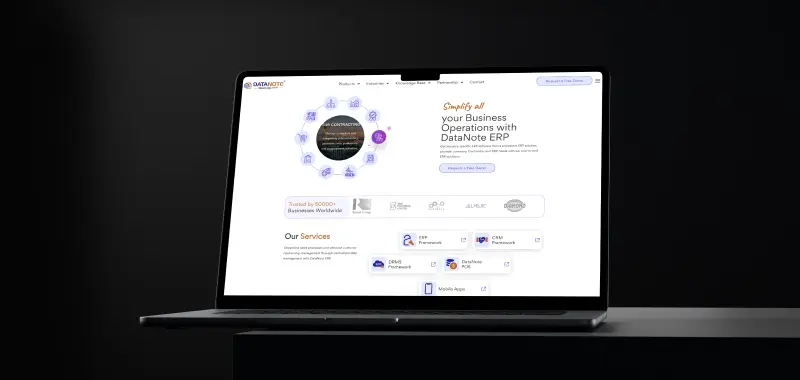
DataNote ERP
A scalable enterprise ERP platform built to unify operations, improve visibility, and support large-scale business processes across industries.
Get In TouchThe Vision
DataNote ERP was built to address a critical gap in enterprise operations — fragmented systems that limited visibility and slowed decision-making across departments. Businesses needed a unified platform to manage workflows, financial operations, and reporting without relying on disconnected tools.
The vision was to create a scalable ERP system that centralizes operations, ensures complete data control, and supports complex business processes across industries. The focus remained on enabling efficiency, improving transparency, and building a system that adapts as businesses grow.
Revenue Generated
Active Global Users
Countries Deployed
Factories Running

The Challenge
Enterprises often operated on multiple systems that created inefficiencies, limited real-time visibility, and increased dependency on manual coordination. Managing workflows across departments required a solution that could unify operations without compromising flexibility or control.
The challenge was to design a system capable of handling complex workflows, large datasets, and multi-location operations while maintaining performance and reliability. It also needed to adapt across industries and support evolving business requirements without requiring constant restructuring.
Our Role
We worked as the end-to-end execution partner, taking ownership from product conceptualization to deployment. This included defining system architecture, building core ERP modules, and ensuring seamless integration across business functions.
Our focus was on delivering a scalable, flexible platform that supports multiple industries while maintaining performance and stability. Beyond development, we ensured the system could be deployed across geographies and evolve with growing operational complexity.

Strategic Approach
How we delivered DataNote ERP
02 — Solution Structuring
The ERP was structured into clearly defined modules covering operations, finance, and reporting. Each module was designed to integrate seamlessly while remaining flexible for different industry use cases. This ensured the system could adapt to varying business processes without compromising usability or requiring extensive customization.
03 — Scalable Architecture
We designed a robust architecture capable of handling large datasets, multi-location operations, and complex workflows. The system was built to support high transaction volumes while maintaining consistent performance. Scalability was a core focus to ensure the platform could grow alongside business requirements without requiring major structural changes.
04 — Iterative Development
Development was carried out in phases, allowing continuous validation across modules and workflows. This approach ensured that each component aligned with real operational needs before scaling further. It also helped reduce execution risk by identifying and resolving issues early in the development cycle.
05 — Performance Optimization
We optimized system performance across data processing, reporting, and workflow execution. This included ensuring fast response times, efficient data handling, and stable performance under load. The goal was to deliver a system that remains reliable even as usage increases across multiple business functions.
06 — Deployment & Scaling
The platform was deployed across different regions and industries, with continuous monitoring and improvements. The focus remained on ensuring smooth real-world usage while enabling businesses to scale operations without disruption. This approach supported long-term adoption and consistent system performance.
02 — Solution Structuring
The ERP was structured into clearly defined modules covering operations, finance, and reporting. Each module was designed to integrate seamlessly while remaining flexible for different industry use cases. This ensured the system could adapt to varying business processes without compromising usability or requiring extensive customization.
03 — Scalable Architecture
We designed a robust architecture capable of handling large datasets, multi-location operations, and complex workflows. The system was built to support high transaction volumes while maintaining consistent performance. Scalability was a core focus to ensure the platform could grow alongside business requirements without requiring major structural changes.
04 — Iterative Development
Development was carried out in phases, allowing continuous validation across modules and workflows. This approach ensured that each component aligned with real operational needs before scaling further. It also helped reduce execution risk by identifying and resolving issues early in the development cycle.
05 — Performance Optimization
We optimized system performance across data processing, reporting, and workflow execution. This included ensuring fast response times, efficient data handling, and stable performance under load. The goal was to deliver a system that remains reliable even as usage increases across multiple business functions.
06 — Deployment & Scaling
The platform was deployed across different regions and industries, with continuous monitoring and improvements. The focus remained on ensuring smooth real-world usage while enabling businesses to scale operations without disruption. This approach supported long-term adoption and consistent system performance.
01 — Problem Understanding
We analyzed enterprise workflows, operational dependencies, and data management challenges across multiple industries. This helped define how different systems interacted and where inefficiencies existed. The goal was to ensure the platform addressed real operational gaps while maintaining clarity across processes and enabling better control over business-critical data.
02 — Solution Structuring
The ERP was structured into clearly defined modules covering operations, finance, and reporting. Each module was designed to integrate seamlessly while remaining flexible for different industry use cases. This ensured the system could adapt to varying business processes without compromising usability or requiring extensive customization.
03 — Scalable Architecture
We designed a robust architecture capable of handling large datasets, multi-location operations, and complex workflows. The system was built to support high transaction volumes while maintaining consistent performance. Scalability was a core focus to ensure the platform could grow alongside business requirements without requiring major structural changes.
04 — Iterative Development
Development was carried out in phases, allowing continuous validation across modules and workflows. This approach ensured that each component aligned with real operational needs before scaling further. It also helped reduce execution risk by identifying and resolving issues early in the development cycle.
05 — Performance Optimization
We optimized system performance across data processing, reporting, and workflow execution. This included ensuring fast response times, efficient data handling, and stable performance under load. The goal was to deliver a system that remains reliable even as usage increases across multiple business functions.
06 — Deployment & Scaling
The platform was deployed across different regions and industries, with continuous monitoring and improvements. The focus remained on ensuring smooth real-world usage while enabling businesses to scale operations without disruption. This approach supported long-term adoption and consistent system performance.
Open the next chapter of your business.
Tell us what you're building, solving, or scaling — and we'll connect you with exactly the right team at Ideaz within one business day.